



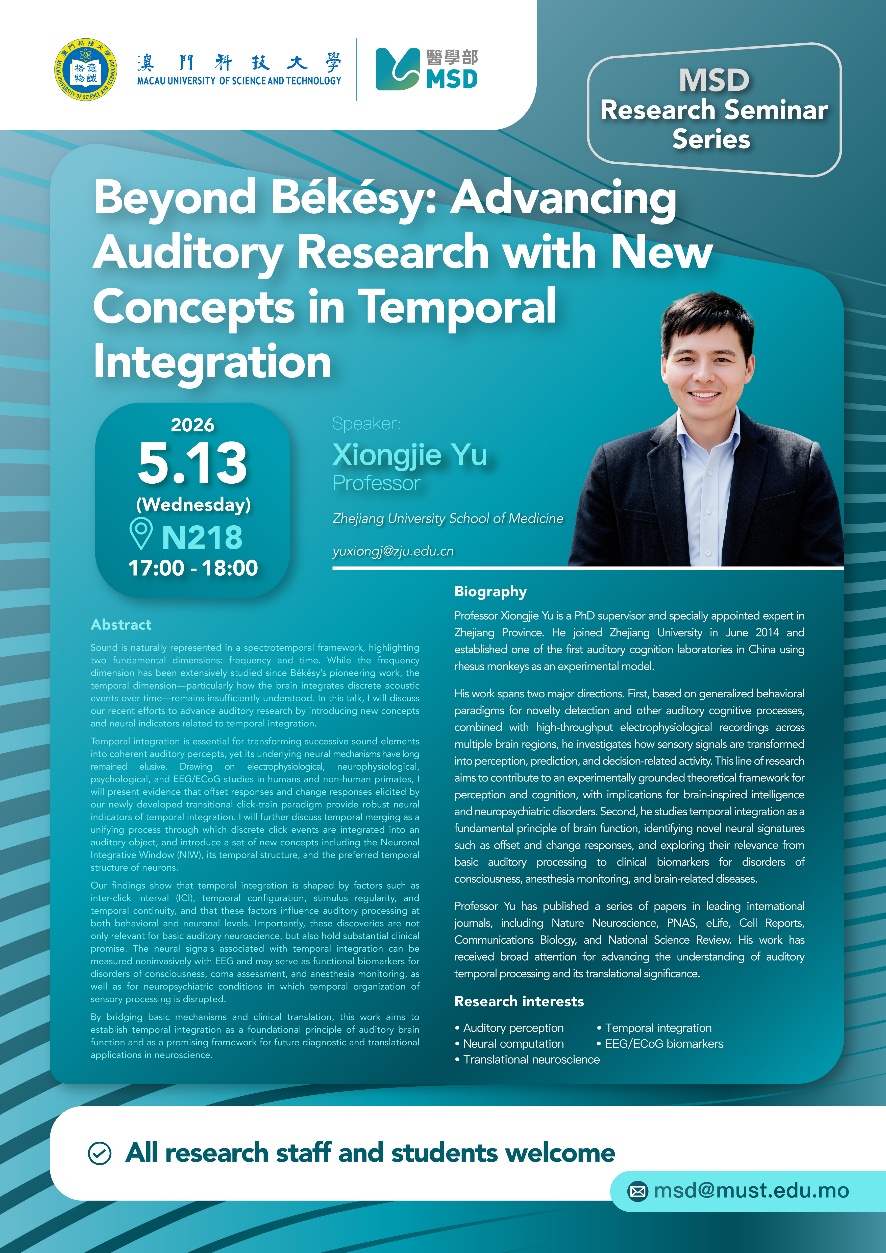
Date: 13th May 2026 (Wednesday)
Time: 17:00 – 18:00
Venue: N218
Theme: MSD Research Seminar Series- “Beyond Békésy: Advancing Auditory Research with New Concepts in Temporal Integration”
Speaker’s Biography
Professor Xiongjie Yu is a PhD supervisor and specially appointed expert in Zhejiang Province. He joined Zhejiang University in June 2014 and established one of the first auditory cognition laboratories in China using rhesus monkeys as an experimental model. His research focuses on auditory cognition, temporal integration, and translational neurophysiology, with particular interest in how the brain organizes temporally distributed sensory information into coherent percepts, decisions, and clinically meaningful neural signals.
His work spans two major directions. First, based on generalized behavioral paradigms for novelty detection and other auditory cognitive processes, combined with high-throughput electrophysiological recordings across multiple brain regions, he investigates how sensory signals are transformed into perception, prediction, and decision-related activity. This line of research aims to contribute to an experimentally grounded theoretical framework for perception and cognition, with implications for brain-inspired intelligence and neuropsychiatric disorders. Second, he studies temporal integration as a fundamental principle of brain function, identifying novel neural signatures such as offset and change responses, and exploring their relevance from basic auditory processing to clinical biomarkers for disorders of consciousness, anesthesia monitoring, and brain-related diseases.
Professor Yu has published a series of papers in leading international journals, including Nature Neuroscience, PNAS, eLife, Cell Reports, Communications Biology, and National Science Review. His work has received broad attention for advancing the understanding of auditory temporal processing and its translational significance.
Research interests
Auditory perception; temporal integration; neural computation; EEG/ECoG biomarkers; translational neuroscience
Seminar Introduction
Sound is naturally represented in a spectrotemporal framework, highlighting two fundamental dimensions: frequency and time. While the frequency dimension has been extensively studied since Békésy’s pioneering work, the temporal dimension—particularly how the brain integrates discrete acoustic events over time—remains insufficiently understood. In this talk, I will discuss our recent efforts to advance auditory research by introducing new concepts and neural indicators related to temporal integration.
Temporal integration is essential for transforming successive sound elements into coherent auditory percepts, yet its underlying neural mechanisms have long remained elusive. Drawing on electrophysiological, neurophysiological, psychological, and EEG/ECoG studies in humans and non-human primates, I will present evidence that offset responses and change responses elicited by our newly developed transitional click-train paradigm provide robust neural indicators of temporal integration. I will further discuss temporal merging as a unifying process through which discrete click events are integrated into an auditory object, and introduce a set of new concepts including the Neuronal Integrative Window (NIW), its temporal structure, and the preferred temporal structure of neurons.
Our findings show that temporal integration is shaped by factors such as inter-click interval (ICI), temporal configuration, stimulus regularity, and temporal continuity, and that these factors influence auditory processing at both behavioral and neuronal levels. Importantly, these discoveries are not only relevant for basic auditory neuroscience, but also hold substantial clinical promise. The neural signals associated with temporal integration can be measured noninvasively with EEG and may serve as functional biomarkers for disorders of consciousness, coma assessment, and anesthesia monitoring, as well as for neuropsychiatric conditions in which temporal organization of sensory processing is disrupted.
By bridging basic mechanisms and clinical translation, this work aims to establish temporal integration as a foundational principle of auditory brain function and as a promising framework for future diagnostic and translational applications in neuroscience.
Students who are interested should register on WeMust-Event.
All research staff and students are welcome to attend this seminar.
For more inquiries, please contact (853) 8897 3411 or email msd@must.edu.mo

