



Date: 27th March 2026 (Friday)
Time: 11:00 – 12:00
Venue: D Hall
Lecturer: Professor Yuk Ming Dennis Lo-Vice-Chancellor and President, The Chinese University of Hong Kong, Li Ka Shing Professor of Medicine, The Chinese University of Hong Kong, Academician of the Chinese Academy of Sciences, Foreign member of the Academia Europaea, 2026 Honorary Doctor of MUST
Theme: Non-invasive prenatal and cancer testing: from dream to reality
Language: English
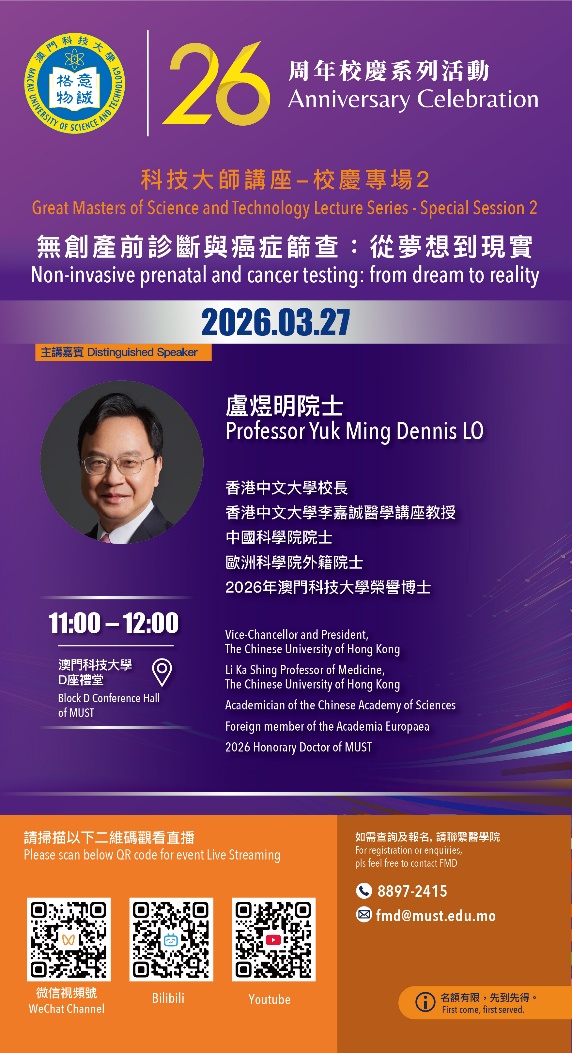
The “Great Masters of Science and Technology Lecture Series - Special Session 2” organized by MUST, will be held on March 27, 2026 at D Hall. Vice-Chancellor and President, The Chinese University of Hong Kong, Li Ka Shing Professor of Medicine, The Chinese University of Hong Kong, Academician of the Chinese Academy of Sciences, Foreign member of the Academia Europaea, 2026 Honorary Doctor of MUST Professor Yuk Ming Dennis Lo will deliver a lecture titled “Non-invasive Prenatal Diagnosis and Cancer Screening: From Dream to Reality.”
Guest Profile:
Professor Dennis Lo assumed office as the ninth Vice-Chancellor and President of The Chinese University of Hong Kong (CUHK) on 8 January 2025. Professor Lo is globally renowned as a pioneer, innovator, and leader in liquid biopsy, and is known as the "father of non-invasive prenatal testing". He is also the Li Ka Shing Professor of Medicine, and the Professor of Chemical pathology of CUHK. Professor Lo received his Bachelor of Arts degree from the University of Cambridge. He then moved to the University of Oxford where he pursued his clinical medical training. Following qualification, he further obtained his Doctor of Philosophy and Doctor of Medicine degrees from Oxford.
Professor Lo joined CUHK in 1997. In the same year, he reported the presence of cell-free fetal DNA in maternal plasma, laying the important foundation for non-invasive DNA-based prenatal testing. He and his colleagues have been instrumental in making non-invasive DNA-based prenatal testing a clinical reality. The non-invasive prenatal test (NIPT) they developed for Down syndrome is regarded as a significant breakthrough by the global scientific community. It has now been adopted in more than 100 countries and used by over 100 million pregnant women worldwide. Furthermore, Professor Lo has developed genome-wide genetic and epigenetic approaches that facilitate the early detection of multiple types of cancer, propelling cancer liquid biopsy into the era of genome-wide analysis. He and his team have successfully developed technologies that allow for their detection and clinical applications.
In recognition of his work, Professor Lo has received numerous international honours and awards. He was elected a Fellow of the Royal Society in 2011 and an International Member of the US National Academy of Sciences in 2013. He received the 2014 King Faisal International Prize for Medicine and became the first Chinese scientist to be honoured with the American Association of Clinical Chemistry (AACC) Wallace H. Coulter Lectureship Award in 2015. In 2016, Professor Lo was selected as the winner of the inaugural Future Science Prize in Life Science, which is regarded as China’s Nobel Prize. In the same year, he was named the Thomson Reuters Citation Laureate in Chemistry, an honour considered as a predictive index of the Nobel Prize. He was also the first Chinese recipient of the Fudan-Zhongzhi Science Award in 2019. In 2021, he received the Breakthrough Prize in Life Sciences, widely known as the “Oscars of Science”, and became the first Chinese scientist to receive the Royal Medal in biological sciences from the Royal Society of London. In 2022, Professor Lo was awarded the Lasker-DeBakey Clinical Medical Research Award, widely regarded as the US’s top biomedical research prize. In 2023, he was elected as a member of the Chinese Academy of Sciences and received the inaugural Tengchong Science Award. In 2024, he became the first Chinese scholar to receive the prestigious Jiménez Díaz Lecture Award. In 2025, Professor Lo was awarded the Richard B. Johnston, Jr., MD Prize in Developmental Biology. He was also elected as a Foreign Member of Academia Europaea.
Abstract:
The presence of cell-free fetal DNA in the plasma of pregnant women was first reported by my team in 1997. Since then, Professor Lo’s team have been pushing forward the translation of this discovery into a new platform of non-invasive prenatal testing (NIPT). NIPT is now used worldwide, allowing the non-invasive screening of fetal chromosomal abnormalities and single gene disorders. A similar technology has also been used for the detection, monitoring and prognostication of cancer. Using an epigenetic base approach, multiple types of cancer can be screened using a single blood test. In this talk, Professor Lo will talk about the journey through which this body of diagnostic technologies were developed and the challenges and impact in bringing such tests to the clinic.
All research staff and students are welcome to attend this lecture.
For more inquiries, please contact (853) 8897 3411 or email msd@must.edu.mo

